

An Interview with Greta Close
Managing Editor at Backcountry Magazine & Mountain Flyer
For decades, magazines like Backcountry and Mountain Flyer have shaped the culture and understanding of skiing and biking. In this conversation, Greta Close, Managing Editor of both publications, reflects on building stories in a more intentional medium, navigating the realities of legacy print, and why physical pages still carry real weight in the outdoor storytelling space.
Can you introduce yourself and share what you spend your time doing?
I’m Greta. I’m the managing editor of Backcountry Magazine and Mountain Flyer. I feel a bit one-dimensional because when you work in the outdoor space and then everything you do outside of work is also outdoors, it’s not very diverse. I’m a biker—mountain biker, gravel biker—and a backcountry skier. Honestly, I just love learning about the world and people, both through sports and separately. I’m living in Washington at the moment, but I spend a good part of the year in Vermont, which is where I’m from.
Do you want to give an overview of Backcountry and Mountain Flyer?
Backcountry Magazine is the journal of record for backcountry skiing. It was founded in Arvada, Colorado, by Betsy and David Harawir and Brian Litz in 1994, and it started as a resource and storytelling outlet for backcountry skiers as the sport was growing. In 2002, Adam Howard—Howie—purchased Backcountry when he heard it was going to be shuttered. He founded Height of Land Publications at the same time, which matters because he went on to move the magazine to Vermont and later purchased Alpinist (climbing), Cross Country Skier (Nordic), and Mountain Flyer (mountain biking)—each of which were either closed or going to be closed. He often says, “If we don’t publish these stories, who will?” There’s just not a lot out there, especially today, for something like cross-country skiing, and doing it with integrity is really important.
Mountain Flyer was started in 2004 by Brian Reapy in Gunnison, Colorado, and he’s still our editor and publisher today. It started to fill a gap—at the time, most mountain bike media was coming out of Southern California or the coasts, and there wasn’t really anyone talking about what was happening in the Rocky Mountains, where he was living and biking. They originally focused a lot on racing—road, mountain, cyclocross—but as the media landscape changed and digital outlets could share results way faster than print, the magazine shifted. It became less regional, less race-focused, and more mountain bike centered—telling meaningful stories that feel authentic and lasting, and that aren’t being told elsewhere. Height of Land purchased it in 2018, so it’s been published through them since then.
So there’s Backcountry, Mountain Flyer, Cross Country Skier, and Alpinist. How do they all fit together, and do you collaborate much across the magazines?
Not really. Alpinist stands alone—they have two full-time editors and it’s quarterly, and they’re dedicated to that magazine. Cross Country Skier is smaller. Traditionally it’s had one dedicated editor, and now Howie is running it, and sometimes the Backcountry editors jump in to help with proofing. I’m kind of the exception, working on two publications. That was timing. I came in summer 2022, and at that point we had two really experienced editors at Backcountry, so I could be part-time there and learn from them, while also helping Mountain Flyer—the editor there is no longer with the publication. Once I got into the mountain bike space, I really didn’t want to give it up. I love biking, and it’s been really fun to be in both.
It’s a good balance. The storytelling coming out of both sports is so different. Backcountry skiing has this technical aspect—avalanche safety, gear, glacier travel, climbing, all the things that factor in. Mountain biking is more about building trail systems and the joy of biking. We do some race coverage—like Sturdy Dirty in Washington, an all-women’s mountain bike race, and Rasputitsa gravel, this heinous mud-season race in Vermont—but it’s different. You don’t have that same risk factor as backcountry skiing, and that changes what we tell and how we tell it.
How did you get into print? Was it something you planned on, or did you kind of fall into it?
Completely by accident. When I was a junior in college, COVID hit. I was supposed to study abroad and didn’t. When senior year came, I was like, “Screw it—I’m not doing online class for my last year.” I moved to Jackson, Wyoming. I’d been a hockey player at the University of Vermont and I’d quit. I’d just gotten into skiing, and suddenly I was launched into this epicenter of the backcountry ski world and the outdoor sports industry. It was amazing—living by the Tetons, skiing every day, touring on the pass. I met a lot of interesting people, and that catalyzed this interest in learning about people in the mountains. I had no background in how radical mountain people are, and what it is to live outside. I’d spent my whole life in a gym or an ice rink training—it was narrow.
When I went back to school the following fall, I got an internship at a newspaper because I was interested in storytelling and I love talking to people. I worked for the Valley Reporter—the local paper for Waitsfield, Vermont, where Sugarbush is—so I did a little ski coverage and I loved it. It’s so cool to call someone and say, “I’m writing about this—can we talk?” and then craft a story. After I graduated, I applied for an internship with Backcountry because they’re based in Vermont. I grew up with it around my house—my dad subscribed—but I don’t know that I spent a ton of time with it. When they hired me, it felt like this really cool blend of a new love of skiing with a growing interest in storytelling, and I was lucky enough to be hired on as associate editor after that.
I never thought this is what I’d be doing. I thought I was going into global development work. I studied religion and global studies—total curveball. Honestly, I didn’t know I was a creative person until I took this job, and that’s been one of the coolest things to learn about myself. Print offers a unique space to be creative. This sounds dramatic, but one of the tragedies of current digital media is that creativity has been sacrificed for advertising space. With a magazine story, especially in niche outdoor publications, our designers think about every aspect—how words go with photos, design elements—it’s beautiful, and it takes time and an eye. On a screen it’s words on white space, ads in between, maybe a couple photos. There are very few positions out there to work in print, period—especially outdoor print—and I feel very lucky I landed one. It’s a really cool thing to create.
How do you use that creative muscle when you’re building an issue?
For Backcountry, we’re very structured and we plan ahead. To write something, a writer has to do it during the winter, but because we publish in winter and making a magazine takes time, if we assign a story this winter, they’re writing about it for next winter. So we email contributing writers in late fall and ask for story ideas. Then the three editors go through pitches and start noticing themes. If we get a bunch of pitches around mental health, we’re like, “We should have a mental health issue.” Then we think about how to balance it—how do you make it not draining? You mix challenges with uplifting stories, or add a cool photo essay with really good skiing.
A lot of what we do is editing. Most pieces are written by freelance contributors, so we work with writers going back and forth two to five times to get a story ready. Some writers are so experienced that their work barely needs anything, but most people—including me—write a great first draft and then you solve the puzzle: reorganize for flow, add context, increase clarity, make it stronger. We design every cover as a group, which is always a challenging creative process—choosing the words that will grab people, resonate with the photo, and reflect what’s inside.
I’d love to hear more about Mountain Flyer from your perspective. How does the risk and technical side of backcountry skiing shape what you publish, compared to the themes and content in Mountain Flyer?
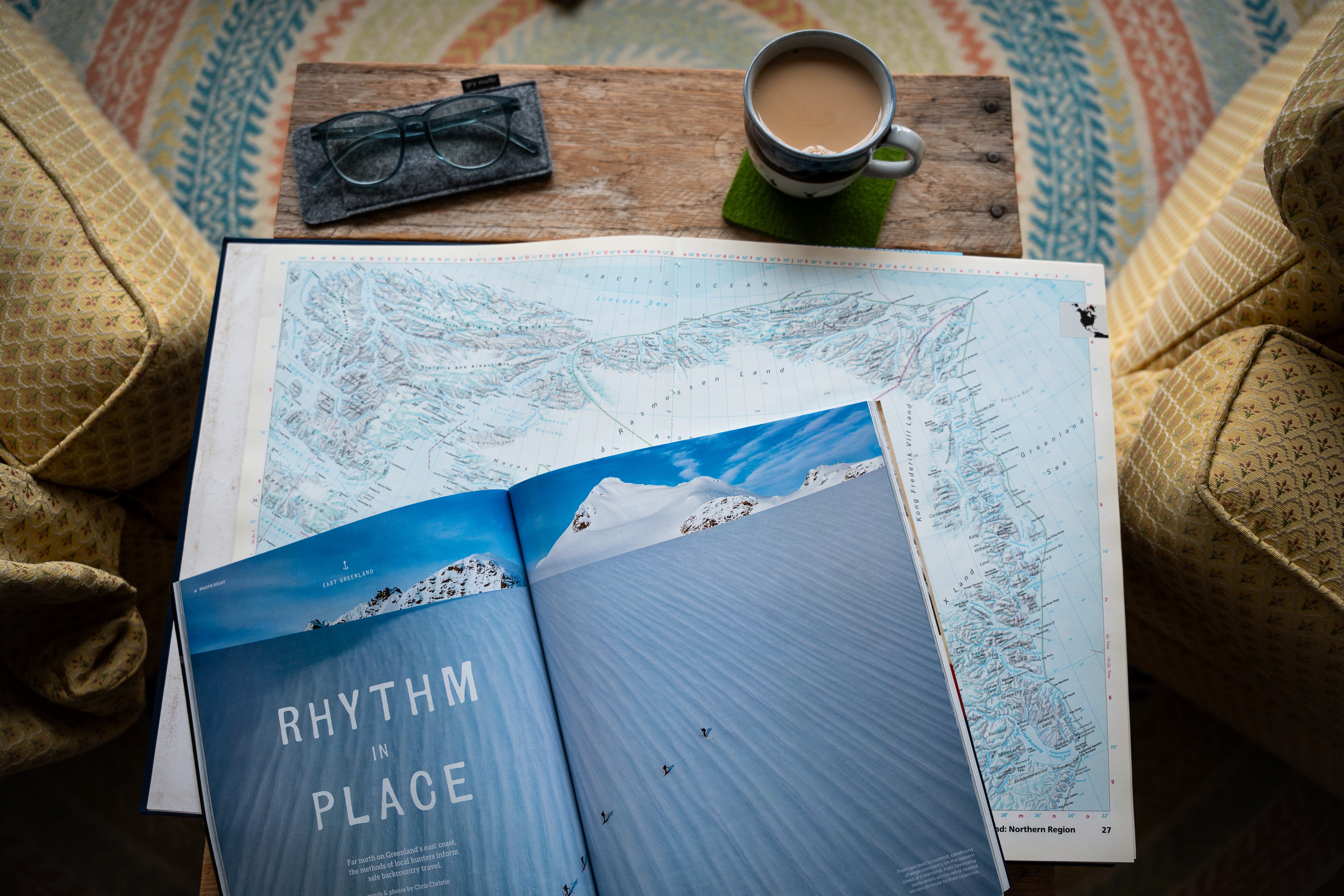
Most pieces in Backcountry mention avalanche safety, because outside of the East Coast—though there are places in the East with avalanche danger—most places we’re writing about have it, and that affects how you ski and everything. But more specifically, Backcountry has a set structure. We run a couple essays in the front, then news stories, then a wisdom column where we interview someone with knowledge to share—often an expert guide. We always run our Mountain Skills column, which is a reported, interview-based piece about a specific skill: crevasse rescue, winter camping, building a first aid kit, and so on. That’s a major place where the technical and safety aspects show up, and we also have a Skills Guide issue every couple years because safety knowledge and gear evolve. We review gear in every issue. The gear guide covers skis, boots, bindings, apparel, and then later issues review airbags, beacons, shovels, probes, crampons, and other critical accessories. And in our longer features—usually about three per issue—we might run pieces about trauma after accidents, or someone reflecting on losing a ski partner. That danger aspect is sadly part of backcountry skiing, and it shapes what we cover.
Mountain Flyer is different. Up until around 2024 it was quarterly—a more standard magazine size, similar to Backcountry. But that wasn’t cutting it. COVID crushed the bike industry, advertiser support was tough, and we needed more subscribers and brand attention. So we redesigned and made a mountain bike magazine that doesn’t really exist in the North American market. We went big: we dropped to two issues per year, the format is much larger, and we made it longer. Stories are mostly long-form—each feature is roughly 12 pages. You get so much depth.
We look for balance: race stories, a piece about a trail consulting company making trails more adaptive-friendly, adventure stories—like a group from BC bikepacking the Lillooet Ice Cap, which is just gnarly—and we always run a maker profile. That’s one of my favorite pieces because biking has so many custom builders and small manufacturers. We’ve featured AVI bike tools in Oregon—precision tools, not mass quantity, but maybe some of the best out there. In the past we’ve done frame builders, too. It’s a cool cohort: people working with their hands making the bikes and parts we ride. There’s a part of the community that loves investing in that—having something handmade and unique.
Because the magazine is so big, we organize it by chapters. That’s fun—picking themes. Our next issue will be “peace, love, and dirt.” Sometimes pitches already fit, sometimes we come up with an idea and find a writer and say, “Would you write this for the love chapter?” It’s more fluid. That reimagination created that. We have some departments in the front and back, but mostly it’s longer pieces, and I like that fluidity.
Before the redesign, what other publications did Mountain Flyer feel like it was competing with in North America?
I think Freehub is our biggest competitor, if not our only print, mountain-bike focused competitor in the U.S. Working in both biking and skiing, we talk a lot about what it is to be a legacy brand. Backcountry has remained pretty similar in approach for almost 30 years. The look has evolved, but there’s continuity in what we publish, the size, and the approach. Both Backcountry and Mountain Flyer are legacy brands, and in today’s world, it’s unique to have been around that long and still operate as fully print.
Backcountry has basically maintained advertiser and reader support through the rise of digital media and digital advertising—and then COVID. COVID was a huge shift: people weren’t going to stores and picking up magazines, and it also wrecked the outdoor industry economy. Brands were hurt, supply chains broke, shipping got weird, product flow got weird. Then it swung the other way—people did outside stuff a ton, gear demand went wild, then there was surplus inventory later. That all affects advertising dollars. Print publications are competing with films, social media, websites—everything—for limited ad dollars. Backcountry was hurt too, but it bounced back.
For Mountain Flyer, we wanted something unlike anything else in the mountain bike media market. And we were also seeing the revival and reimagination of OG brands like Mountain Gazette and Summit Journal. That felt like a signal—people want print, but maybe not the typical newsstand grocery-store magazine. The response to the redesign has been really positive. It’s eye-catching and fun to sit down with, and it doesn’t pile up—two issues a year gives you a long time to spend with it. With so much content coming at you through your phone, you’re less likely to spend time reading print, so you want the print thing to be special—like a treat.
As someone working at a legacy brand, how do you look at the growth of indie print?
Personally, I think it’s so cool to see people creating indie publications. Looking at New Mountain Mag, you can see the passion, creativity, and aesthetic touch. I loved flipping through it—how some pages are colored, small inset photos—it feels very different from what we do, and it’s fun. The challenge of being a legacy brand is that you have an identity that’s been cultivated over many years. You have an audience that trusts you, and you don’t want to alienate them. So remaking something requires care. With Mountain Flyer, we spent at least a year talking about what it would look like—so many conversations, down to paper choice.
One exciting thing is seeing young people who grew up in a digital world wanting to make something concrete. They know what magazines and books are, but they’re putting together something new—cool adventure stories, different angles, different communities. When everything is at your fingertips, you can see every result instantly and watch every run. Instagram is full of insane videos. You need something different to capture people. I think people want something that reconnects them with why they love these sports and what they can actually do outside. I can’t do a double backflip, but maybe I can go on a big mission with friends.
Ori comes to mind too—trying to get people to write about their locale, not just traveling somewhere wild. That’s a unique perspective compared to historical travel writing. Bikepacking Journal isn’t super new, but they’ve nailed the combo: a website where you can learn everything about bikepacking, and a beautiful magazine alongside it. That’s interesting fodder for legacy brands. There’s inspiration happening in this new wave, and a lot of creative freedom.
Switching gears—on a personal level, what have been some of the coolest stories you’ve gotten to write?
One that comes to mind is Ecuador. The funny thing is, my boyfriend and I had two weeks free and we were like, where can we go? We didn’t want to be in Europe or North America, and we picked the cheapest flight. It was Ecuador. I remembered a woman we’d written about in Backcountry, Cleona Garcia, an IFMGA guide from Ecuador. I got her email and reached out like, “We’re coming. I think there’s mountain biking based on some research—can you connect us with someone? There might be a story.” Total shot in the dark.
We connected with a couple who run an organic farm. The farm was founded by the woman’s parents, and they’ve taught thousands—tens of thousands—of Indigenous people how to sustainably farm because that knowledge had been lost due to earlier initiatives. They provide organic produce—yogurt, chickens, all of it—to their community. And the man is a mountain bike guide. They’re huge mountain bikers, racing too. The mountain bike scene there is young but growing.
I love stories that expand beyond sport. Mountain biking was the entry point, but it became about community and sustainability and culture. We rode Cotopaxi volcano, which was insane. We had dinner at their farm and everything we ate was from the farm. What they’re doing for their community is powerful. It took two years before I got to write about it, but it ran in the last issue of Mountain Flyer. In the meantime we were reimagining the magazine, so it was like, where does this story live? What chapter does it fit in? Seeing it come to life in the redesigned print format was really cool.
And then Kazakhstan—most people don’t know where it is, or they confuse it with Kyrgyzstan. Kazakhstan is the ninth largest country in the world. It was way more under the radar, and skiing was a unique way to connect with local culture and communities. I love travel, I love being immersed in a place, and sport is this common ground that makes that possible.
And sometimes the coolest story isn’t far away. The first thing I ever wrote was an essay about my dad living in Jackson maybe 40 years before I did. I got to interview him and reflect on a shared experience. It was like 800 words, but it’s special to have that experience crafted and living permanently on the page.
How do you feel like you’ve grown as a writer? What’s helped you most?
Editing is the biggest, best way to learn. I’ve always been better at writing than math, so there was some natural ability there. But the fastest way to learn is reading other people’s writing and thinking about how to make it better—that’s what being an editor is.
I was lucky. The managing editor when I started at Backcountry had a master’s in creative writing, and he made a cheat sheet for how to edit a piece. Our editor-in-chief, Betsy, is also a great editor. Working with people like that is huge. You see how they edit your writing, you learn how they approach structure, then you bring that to the writers you work with.
Now when I read a story, it’s clear what it needs—more context, a better hook. And when I’m writing, I think about those same things. On my trip to Kazakhstan, we were skinning through a thunderstorm. It was so crazy, and I immediately thought, “This is the hook.” Those distinct, vivid moments draw readers in.
Also just reading really good writers—when someone captivates me, I’m like, how do I use words to create that same feeling? That’s hard. But it’s a skill and a talent, and I’m always trying to learn it.
Internships matter too. I started as an intern, and being thrown into the world and seeing what it takes to put a story together is informative. We try to give interns chances to edit other people’s work, because it’s rare to have that opportunity otherwise.
What’s been inspiring you lately—either in print or just in life, films, anything?
I went to a really cool conference hosted by Winter Wildlands Alliance in the fall—their Grassroots Advocacy Conference. With public lands being threatened for sell-off and losing protections, it was inspiring to be in a space with people working to protect the places we recreate on. From my position, I feel adjacent. We tell the stories, but we’re not necessarily the experts doing the work. It was cool to watch people doing concrete advocacy, and it made me want to be more involved.
I also went to the Banff Film Tour when it came through Seattle, and there was an amazing film about adaptive mountain biking in Vermont. I’m from Vermont and I’ve ridden those trails, so it had personal gravity. They followed a few characters who’d gone through accidents and ended up paralyzed in different ways. They showed the accident, the everyday challenges, then the joy of getting on an adaptive bike, and then building a trail system that actually works for adaptive bikes. Most people don’t realize a standard trail often isn’t wide enough. If it were just a little wider, adaptive riders could use it. And adaptive riders aren’t necessarily looking for an easy trail—they’re looking for a trail their bike can physically ride, and then they’ll go for it.
I love stories that aren’t the biggest, fastest objective, but are really impactful. My dad was an adaptive athlete later in his life, and it brought him a lot of joy. As able-bodied athletes, we can get caught up in wanting to do the hardest things and forget the privilege of just being able to do this stuff outside. For someone in a wheelchair, getting out on a bike can be such a freeing experience. That film captured that joy really well.
To wrap up—what are you excited to keep seeing in the print space, with Mountain Flyer, Backcountry, or print as a whole?
I’m excited about continuing to find stories that are flying under the radar, because those are so fun to read. There are always wider, important stories, but there are also people doing really inspiring things that don’t get coverage. Print is uniquely good at giving those stories a home—things that won’t necessarily get picked up by Instagram or a film. People making change inside their communities.
I’m also excited to see how indie publications make themselves viable. The economy is challenging, and it’s a hard business to sustain—you either need enough people to buy it, or brands to support it, and marketing a print product takes investment. I’m excited to see how new publications keep creating and inventing themselves. Imagining what New Mountain Mag could be in five years is exciting—where it started, what it could grow into.
And I hope we keep striking the balance: staying true to who Backcountry and Mountain Flyer are, while growing where it matters.
I also hope more people realize the value of print. It’s a unique platform for storytelling. It’s an enjoyable break from today’s world. And it gives photography such a nicer place to live than a tiny screen.
It’s hard to put a value on seeing a photo printed on paper, but if you’ve seen it, you know it does the image so much more justice. We don’t get that today.
And one thing you don’t always think about is permanence. Try finding one post from three years ago that you loved—it’s like a needle in a haystack. But if you subscribe to a magazine and keep them on your bookshelf, those stories live there. That cover, that opening spread—if someone has a copy, it’s still living on in a concrete way. So much today gets scrolled past and never seen again.